Godsent Ogbebor
At 92, Paul Biya Extends His Grip on Cameroon After Four Decades in Power
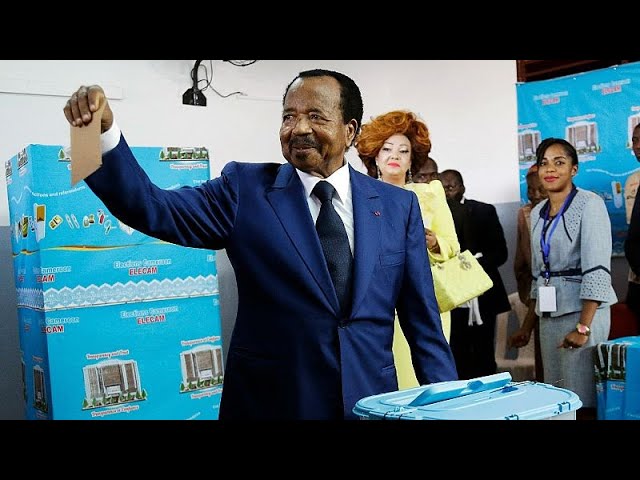
In a result that surprised few across Central Africa, 92-year-old Paul Biya has once again emerged victorious in Cameroon’s presidential election, securing an eighth term that stretches his already 43-year rule.
The outcome reinforces Biya’s place as one of the world’s longest-serving leaders and for many Cameroonians, the only president they have ever known.
Voting took place Sunday across the country’s ten regions, with more than eight million citizens eligible to cast their ballots. As polls closed, attention quickly turned to the aging leader whose steady yet distant presence has shaped Cameroon since 1982.
Biya, who succeeded Ahmadou Ahidjo, has now ruled longer than most of his nation’s population has been alive, more than half of Cameroonians are under 20.
His victory, though expected, underscores a deeper political question: why does Cameroon seem unable to imagine a future without him?
Biya’s main challenger, 79-year-old Issa Tchiroma Bakary, a former employment minister and longtime member of Biya’s government, drew surprising enthusiasm during the campaign.
In the northern town of Maroua, thousands of young supporters waved banners and chanted “Tchiroma the Saviour,” calling for an end to decades of political stagnation.
Yet, despite the growing hunger for change, Biya’s powerful political machinery and long-entrenched system left little room for true competition.
The election was held amid what analysts described as a controlled political space. While eleven candidates were on the ballot, the absence of Maurice Kamto, Biya’s strongest opponent in 2018, cast a shadow over the vote.
Kamto was disqualified by the Constitutional Council earlier this year, a move rights groups such as Human Rights Watch said stripped the election of its credibility.
Political scientist Stephane Akoa captured the mood aptly: “We shouldn’t be naive. The ruling system has ample means to get the results it wants.” Yet, he noted, the campaign felt livelier than usual a small sign that public engagement, especially among the youth, may be shifting.
In recent months, Biya kept his traditional low profile, appearing only once publicly since May, a campaign stop in Maroua, where his speech was brief but symbolic.
The Far North region, home to more than 1.2 million eligible voters, was once a reliable base for the ruling party. But that loyalty has weakened in recent years, as economic hardship and security concerns have deepened discontent.
Cameroon’s economy remains one of the most diversified in Central Africa, rich in agriculture and natural resources, yet about 40 percent of its people live below the poverty line. In cities like Douala and Yaoundé, unemployment hovers around 35 percent.
For a generation of young people growing up with smartphones and social media, the contrast between the country’s potential and its persistent poverty is a source of growing frustration.
Read also: D’Tigers Cruise Past Cameroon to Reach AfroBasket Quarter-Finals
Still, those frustrations have largely remained online. “There is a positive sign of change,” Akoa said, “but perhaps not strong enough to bring young people onto the streets, as we saw in Tunisia or Madagascar.”
Across the capital, discussions about Biya’s latest victory are marked by resignation more than surprise. Many citizens express fatigue with what they call a “recycled democracy,” where elections occur regularly, but outcomes feel predetermined. “We vote because it is our right,” said a university student in Yaoundé, “but we don’t expect much to change.”
Critics say Biya’s long stay in power has hollowed out Cameroon’s institutions. The opposition remains fractured, parliament offers little real oversight, and most state structures revolve around loyalty rather than performance.
Yet, Biya’s supporters argue that his leadership has kept the country stable in a turbulent region plagued by coups and conflict.
“Cameroon has not collapsed,” said a senior ruling party member. “Under Biya, we have peace and steady governance. That matters.”
But that peace has come at a cost. The government has long been accused of suppressing dissent, censoring media, and detaining opposition figures. In Anglophone regions, where separatist tensions have simmered since 2016, security forces have clashed with rebels, displacing thousands.
The president’s muted handling of the crisis, often issuing statements from his residence in Geneva has drawn criticism at home and abroad.
Observers from the African Union and other international bodies were deployed across the country to monitor the vote.
Around 55,000 local and foreign observers were accredited, but many said their presence was symbolic. “Monitoring doesn’t change the system,” one observer admitted privately. “The structures are too deeply rooted.”
Despite these challenges, many Cameroonians still cling to a quiet hope for renewal. Younger politicians and civic leaders have begun calling for reforms, advocating for decentralization and youth participation in governance. But such efforts often meet bureaucratic resistance in a state built on hierarchy and control.
As Biya begins yet another term, questions about succession linger. His age and health have become subjects of speculation, particularly given his rare public appearances. Yet, the ruling Cameroon People’s Democratic Movement remains silent on any transition plans.
Outside official circles, discussions are bolder. Civil society groups and political analysts have begun to ask what Cameroon will look like “after Biya.” For now, that remains an open question, one the 92-year-old leader appears in no hurry to answer.
The Constitutional Council has until October 26 to declare the final results, but the outcome is clear: Paul Biya remains president, once again reshaping the arithmetic of power in Yaoundé.
For Cameroonians, it is another reminder that the nation’s story from independence to the present, continues to revolve around one man’s enduring rule.
As one voter in Douala put it, “In Cameroon, presidents change less often than the seasons. We are used to it. But maybe, one day, the wind will shift.”