
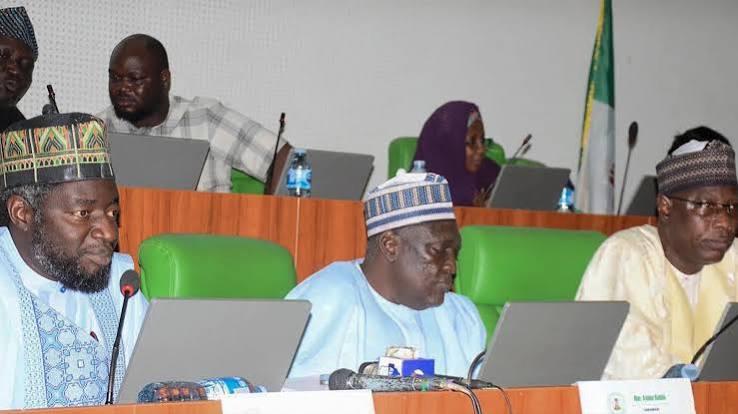
Reps uncover fake PFIPC documents
The House of Representatives has uncovered documents it said were fabricated or altered to present the Presidential Foreign Intervention Promotion Council as a legitimate federal institution.
The discovery was made by the ad hoc committee investigating the council, which said the purported organisation had no valid law, executive order or other government instrument establishing it.
The committee, chaired by Yusuf Gagdi, said its investigation also traced 58 bank accounts and 39 people to Prince Adeniyi Adeyemi, who was presented as the Director-General of the organisation and was also identified in some records as Adeyemi Matthew.
More than 30 of the accounts were reportedly operated in the names of about nine agencies, companies, foundations or related entities. The committee said the accounts were linked through Bank Verification Number and other identifying information associated with Adeyemi.
The lawmakers said they were still checking registration records, account mandates, ownership details, signatories and transaction histories and had not concluded that every account, entity or transaction identified was unlawful.
Read more: Reps Move to Boost Military Strength, Veterans’ Welfare with New Defence Bills
The investigation followed a July 8, 2026 resolution of the House directing the committee to examine how the PFIPC was included in the Federal Budget Framework.
According to the committee, the organisation presented itself as a federal institution despite there being no valid Act of the National Assembly, gazetted enactment, Presidential Executive Order, administrative instrument or other lawful authority establishing it.
The committee said several documents used to support the organisation’s claims contained evidence of fabrication, forgery, alteration and impersonation.
One of the documents examined was a purported presidential appointment letter for Adeyemi as Director-General, said to have been signed by the Chief of Staff to the President, Femi Gbajabiamila.
The State House, however, told the committee that no such appointment was made or approved by the Presidency and that Gbajabiamila did not issue or sign the letter.
The committee also said the letterhead was not an authentic State House letterhead, while its reference number, format, language and other administrative details did not match official correspondence.
A purported approval for the establishment of an organisation described as the Presidential Economic Advisory Council was also found not to have originated from the Presidency, State House or any authorised federal body.
Similarly, a document presented as Presidential Executive Order No. 5, dated February 24, 2026, was found by the committee not to be an authentic Executive Order and was not issued or approved through lawful presidential procedures.
The committee also examined a purported Act of the National Assembly establishing the organisation and found that it had not been enacted by Parliament, passed by both chambers, assented to by the President or gazetted.
It said part of another document appeared to have been electronically altered or replaced to create the impression that the National Assembly had passed legislation establishing the organisation.
Read more: Reps Vote Opens New Chapter in Nigeria’s Fight Against Insecurity
The lawmakers further uncovered a letter dated November 7, 2024, purportedly written by the State House to the Office of the Accountant-General of the Federation requesting an administrative code for the PFIPC.
The letter allegedly carried the name of Akambi Adewale, described as a director in a purported State House directorate.
The State House, however, informed the committee that the directorate did not exist in the form presented and that no officer known as Akambi Adewale served in the stated position.
The committee also identified more than 12 entities it said were directly or indirectly associated with Adeyemi.
They included the Confederation of United Nations Youths, FCT Investment Promotion Agency and Public-Private Partnership, Foreign Investment Promotion Agency, United Nations Youth Global Agency, United Nations Youth Global Foundation, World Entrepreneurship University Limited and Olubadan of Ibadan Foundation.
The similarities in their names, objectives, management structures, signatories and bank account relationships raised concerns for the committee over the possible use of government, international, investment, educational, charitable and United Nations-related identities.
It said it was investigating whether the entities were created or used to give the organisation artificial credibility, attract funds and investments, obtain government recognition or facilities, or persuade members of the public to make payments.
The committee also said 39 people had been presented as employees of the organisation across junior, intermediate and senior levels.
It is investigating their recruitment, appointment letters, identity cards, salaries and allowances, as well as allegations that some applicants were required to pay money to secure employment.
The lawmakers said they would distinguish between people who were deceived into believing the organisation was genuine and those who knowingly participated in or benefited from its activities.
The investigation also examined an allegation by a company that Adeyemi induced it to pay about N400m in four instalments after promising that it would receive a contract involving the renovation, furnishing or improvement of a residence allegedly allocated to him as Director-General.
The company reportedly told the committee that its representatives were taken to a residential property in Abuja and informed that it was the purported official residence.
The committee said it was tracing the payments, identifying account holders and beneficial owners, and checking the ownership and status of the property.
It added that, if established through the appropriate investigative and judicial processes, the allegations could amount to offences including fraudulent misrepresentation, obtaining money by false pretence, impersonation, conspiracy and forgery.