AAC Heads to Court Over Tinubu’s Extended Absence
The African Action Congress has taken President Bola Ahmed Tinubu’s prolonged absence from Nigeria to the Federal High Court in Abuja, asking the court to determine whether the extension of his stay abroad complied with the 1999 Constitution.
The suit, filed by the party’s National Legal Adviser and human rights lawyer, Inibehe Effiong, challenges the President’s failure to transmit a written declaration to the National Assembly following the extension of his vacation.
The AAC is also challenging the National Assembly’s failure to pass a resolution enabling Vice President Kashim Shettima to perform the functions of Acting President after the period specified under Section 145(1) of the Constitution.
The suit, marked FHC/ABJ/CS/2353/2026, names Tinubu, Attorney-General of the Federation and Minister of Justice, Lateef Fagbemi, Senate President Godswill Akpabio, Speaker of the House of Representatives Tajudeen Abbas and the National Assembly as defendants.
Read also: Tinubu’s 21-Day Absence Sparks Constitutional Dispute
In a 30-paragraph affidavit supporting the case, AAC National Secretary Oshiokhue Philip Ikpeminoghena said Tinubu left Nigeria on August 30 and later announced an extension of his vacation on September 21.
The party is asking the court to declare that the alleged failure to transmit the required written declaration to the Senate President and Speaker was unlawful and unconstitutional.
It also wants the court to declare that the National Assembly’s failure to pass a resolution authorising Shettima to assume the functions of Acting President after Tinubu’s absence exceeded 21 days was contrary to the Constitution.
The AAC further seeks a perpetual injunction restraining Tinubu and future presidents from proceeding on vacation without complying with Section 145(1), as well as an order directing relevant constitutional authorities to follow the provisions governing the transfer of presidential functions whenever a President is unable to perform his duties.
No date has been fixed for the hearing.
The legal challenge comes as the Presidency continues to defend Tinubu’s extended stay in Europe, maintaining that he has remained involved in the affairs of government.
Special Adviser to the President on Information and Strategy, Bayo Onanuga, said Tinubu was “hale and hearty” and continued to work during his absence.
Onanuga argued that modern communication technology meant the President did not need to be physically present in Abuja to direct government business.
Read also: Tinubu, Ruto, Guterres Renew Push for Permanent African Seats at UN
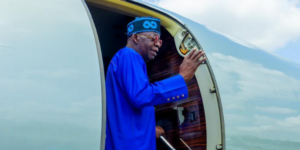
Tinubu left Nigeria for London on August 30 before travelling to Paris, where he held meetings with French President Emmanuel Macron and businessman Vincent Bolloré.
The Presidency later announced that his working vacation had been extended, while Shettima represented Nigeria at the 81st United Nations General Assembly in New York.
The Vice President delivered Nigeria’s national statement during the high-level segment of the General Debate.
The Presidency has said Tinubu would return to Nigeria this week to participate in activities marking the country’s 66th Independence Anniversary.
Meanwhile, the President’s absence has also become a political issue ahead of the 2027 presidential election.
The African Democratic Congress Presidential Campaign Council said its candidate, former Vice President Atiku Abubakar, would provide what it described as a physically present and responsive presidency if elected.
The council’s Director of Media and Publicity, Kola Ologbondiyan, said Nigerians needed a President who was physically available to respond to national challenges.
The debate over Tinubu’s absence has also drawn comments from Peter Obi, while opposition groups have questioned the President’s decision to remain abroad beyond the period initially announced.
With the AAC case now before the Federal High Court, the dispute has shifted from political criticism to a formal legal challenge over the constitutional requirements governing a President’s prolonged absence from the country.