
By Okpere Sharon,
Trump Hosts African Leaders, Launches bold Shift From Aid to Trade
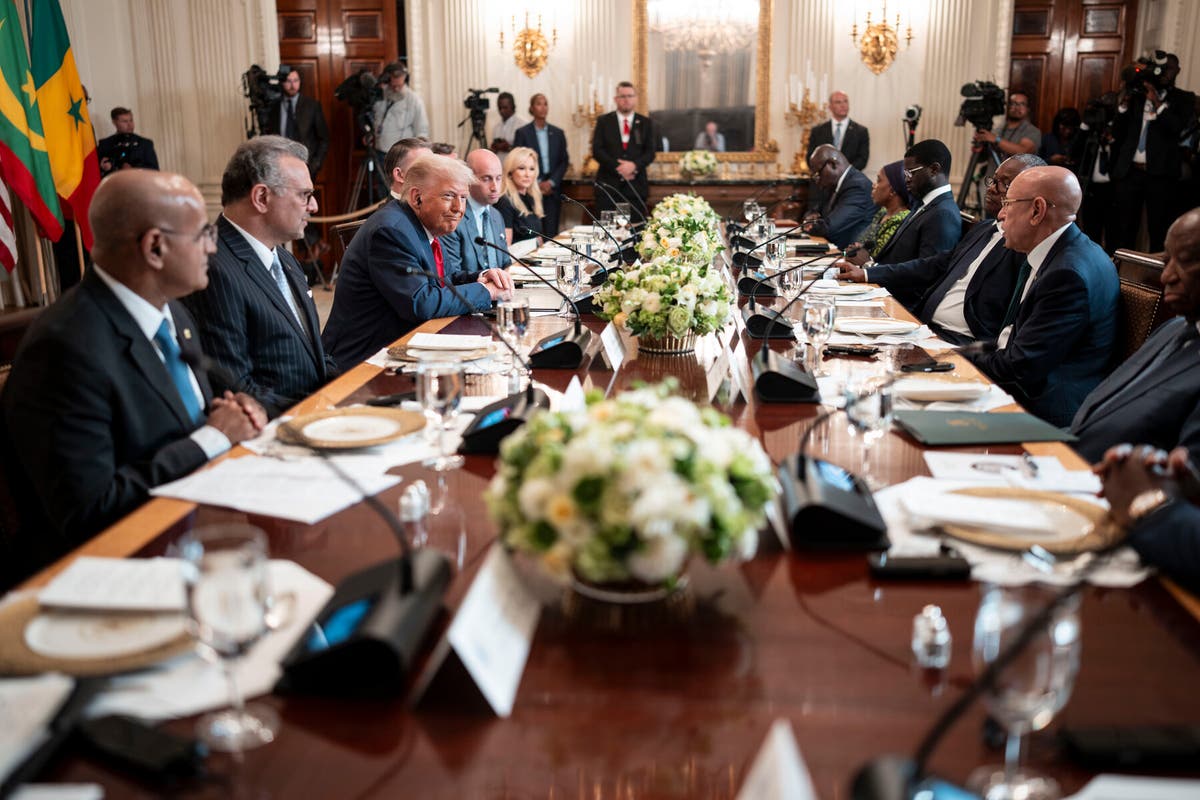
President Donald Trump on Wednesday hosted five African heads of state at the White House, announcing a major shift in U.S. policy toward the continent, moving away from foreign aid and focusing instead on trade and economic partnerships.
The meeting, which included the leaders of Gabon, Guinea-Bissau, Liberia, Mauritania, and Senegal, was held in the State Dining Room. President Trump told the visiting leaders that his administration had closed the U.S. Agency for International Development (USAID) and was prioritizing trade deals and business investments in Africa.
“We’re shifting from A.I.D. to trade,” Mr. Trump said. “We’re working hard to create new economic opportunities between the United States and many African nations. There’s great potential in Africa.”
The change in approach comes after years of cuts to U.S. humanitarian support in African countries. Liberia, for example, previously received U.S. aid equal to 2.6% of its national income, the highest share for any country in the world, according to the Center for Global Development.
The meeting also touched on immigration. President Trump asked the African leaders to help his administration reduce the number of African migrants who overstay their visas in the United States.
He proposed partnerships known as “safe third-country agreements” in which migrants who are not citizens of certain nations could still be returned there under special arrangements.
Mauritania and Gabon are two of the countries the U.S. has been negotiating with on this issue. According to diplomatic sources, discussions have been ongoing for several months.
Alongside President Trump were key figures from his administration, including Massad Boulos, a senior adviser on African affairs, and Stephen Miller, the top adviser behind the Trump immigration policy.
While the U.S. government is working to build new trade ties, it is also reportedly considering expanding its travel ban to four of the five countries represented at the meeting. Only Guinea-Bissau is not currently under review for such restrictions, according to a recent cable from the State Department.
Despite these tensions, the African leaders appeared eager to strengthen economic ties with the United States.
President Mohamed Ould Ghazouani of Mauritania told Mr. Trump that his country had vast natural resources and was ready for investment. “We have minerals, we have opportunities,” he said.
President Brice Clotaire Oligui Nguema of Gabon encouraged U.S. companies to invest but warned that his country was open to all global partners. “If you don’t come, others will,” he said, noting that Gabon has already signed over $4.3 billion in investment deals with China.
Guinea-Bissau’s President Umaro Sissoco Embaló played a major role in organizing the summit. The White House said the event was initially planned as a bilateral meeting and later expanded to include other nations.
At one point in the meeting, President Trump appeared surprised when Liberian President Joseph Boakai addressed the gathering in fluent English. “Where did you learn to speak so beautifully?” Trump asked, despite English being Liberia’s official language.
Observers say the summit reflects a broader strategy by the Trump administration to compete with China’s growing influence in Africa.
According to the Brookings Institution, China has made significant investments across the continent and has built major infrastructure, including Guinea-Bissau’s only highway.
“China has outpaced the U.S. in both political and economic engagement across Africa,” said Dr. Landry Signé, a senior fellow at Brookings. “This summit seems to be the Trump administration’s way of trying to reassert itself in the region.”
Read Also: Oliseh Warns Osimhen Against Galatasaray Move, Urges Premier League Switch
The meeting also followed recent U.S. involvement in peace efforts between Rwanda and the Democratic Republic of Congo. President Trump said he would soon invite leaders from those countries to Washington to finalize a peace agreement. He also mentioned ongoing U.S. efforts to help bring peace to Sudan and Libya.
“There’s a lot of anger on your continent,” Mr. Trump said to the visiting presidents. “But we’ve helped solve a lot of it.”
However, violence continues in parts of Eastern Congo despite the recent peace efforts.
The meeting ended on a note of cooperation, with the leaders expressing interest in future deals with the United States.