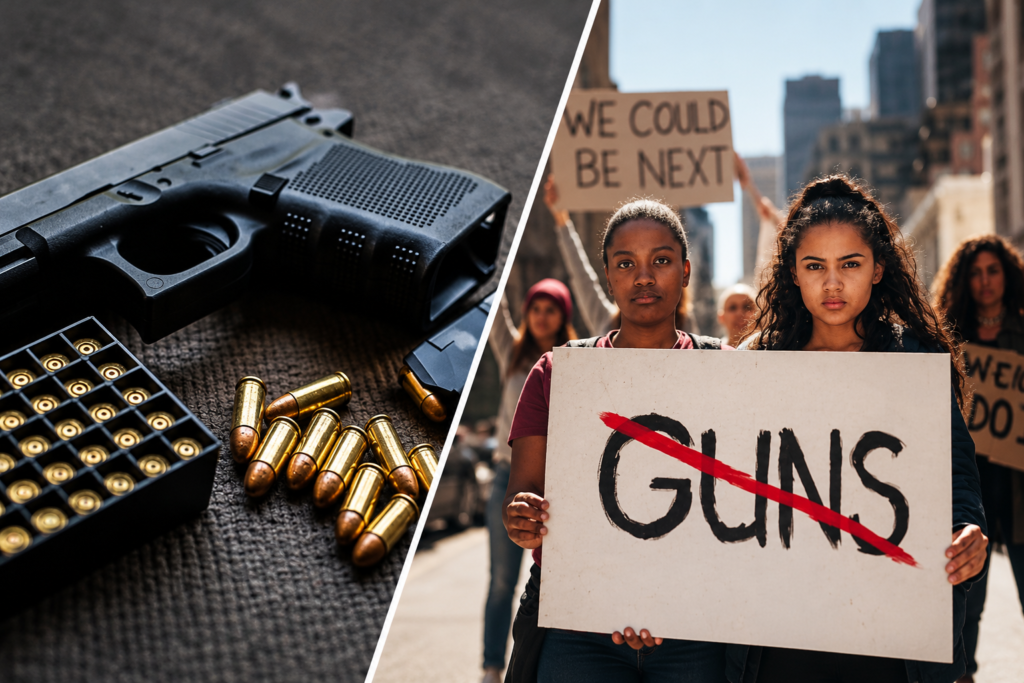
Would More Guns Make the World Safer?
By Shalom Ikuvbogie
When governments fail to protect their citizens, the demand for self-defence becomes harder to ignore. In communities troubled by kidnapping, armed robbery and violent attacks, people may reasonably ask: if the police cannot always arrive in time, should citizens be allowed greater access to firearms?

Supporters argue that responsible citizens should have the means to defend themselves. Opponents warn that more guns could turn ordinary disputes into deadly encounters. From the United States to the United Kingdom and Nigeria, the debate raises a difficult question: can more guns protect a society without making it more dangerous?
The argument for wider access is straightforward. Police cannot be everywhere at once, and an armed criminal may attack long before help arrives. Supporters believe that knowing a potential victim is armed could discourage an attacker. In communities where people feel abandoned by the authorities, this is not an argument that should be dismissed lightly.
But the ability of a gun to save someone in one encounter does not prove that making firearms more widely available will reduce violence overall.
The United States offers an important example. Although civilian gun ownership is protected by the Second Amendment, firearm violence remains a serious concern. The US Centers for Disease Control and Prevention recorded 15,364 firearm homicides in 2024. The figure alone does not prove that gun laws caused the violence, but it challenges the assumption that widespread access guarantees safety.
Read Also;
https://share.google/zBrWKLxBb5WKYSoKtGun Violence – Amnesty International https://share.google/zBrWKLxBb5WKYSoKthttps://share.google/zBrWKLxBb5WKYSoKthttps://share.google/zBrWKLxBb5WKYSoKt
Gunmen Kill Nine After Attacking Stopped Bus In Plateau
Police Recover Cash, Firearms After Gun Battle in Anambra
Research published in the Annual Review of Criminology in 2026 adds to that concern. Researchers Andrew Morral and Rosanna Smart concluded that the weight of evidence indicated that more permissive concealed-carry laws increased homicide and violent crime rates. This finding does not establish that every form of civilian gun ownership increases violence. It does, however, undermine the claim that allowing more people to carry firearms necessarily deters criminals.
The United Kingdom offers a different perspective. Civilian firearm ownership is permitted under restrictions, including licensing requirements for many types of guns. Yet violence persists. The Office for National Statistics recorded 205 homicides involving knives or other sharp instruments in England and Wales in the year ending March 2025.
That figure does not prove gun restrictions have failed, nor does it show that more guns would prevent knife attacks. It demonstrates why the debate requires more than simple comparisons: the existence of one form of violence cannot establish that introducing greater access to another weapon would improve public safety.
In Nigeria, the question is particularly urgent. Kidnapping, banditry and armed attacks have left communities fearful for their lives and livelihoods. People who believe that help may not arrive in time understandably question why they should be denied the means to protect themselves.

Be that as it may, Nigeria does not completely prohibit civilian firearm ownership. Its Firearms Act provides for licensed possession, although a licence is not an automatic right. The debate is whether access should be expanded and whether the country has the capacity to regulate it effectively.
A national small-arms assessment published by the Small Arms Survey in 2021, based on research conducted in 2016, estimated that about 14 per cent of Nigerian households possessed at least one firearm at the time. This is not a current estimate, but it highlights the importance of understanding existing patterns of firearm possession.
Supporters may ask why responsible citizens should face restrictions when criminals already possess guns. Yet the opposing question is equally important: if authorities struggle to control illegal weapons, could expanding legal access create more opportunities for theft, diversion and misuse?
Wider access would require effective background checks, secure-storage rules, reliable monitoring and the ability to trace missing firearms. Without these safeguards, a policy intended to protect citizens could expose others to greater danger. At the same time, restrictions alone cannot solve insecurity. Governments must improve policing, intelligence gathering, emergency response and the prosecution of offenders. Otherwise, public demand for private weapons will continue to grow.
The experiences of these three countries cannot be compared without considering their different laws, institutions and security conditions. What works in one country may not work in another. Any proposal to expand civilian gun access in Nigeria must therefore be judged against Nigerian realities, not assumptions borrowed from abroad.
Watch this;
Ultimately, an armed citizen may successfully defend themselves. That possibility matters. But public policy must also consider the wider consequences for people who never choose to own a firearm but may still become victims of its misuse.
The real question is not whether guns can save lives. They can. It is whether allowing more people to possess or carry them would save more lives than it puts at risk. Until credible evidence and effective safeguards provide a convincing answer, more guns should not automatically be mistaken for greater safety.