
Godsent Ogbebor
Nepal floods leave hundreds of foreigners missing as rescue efforts intensify
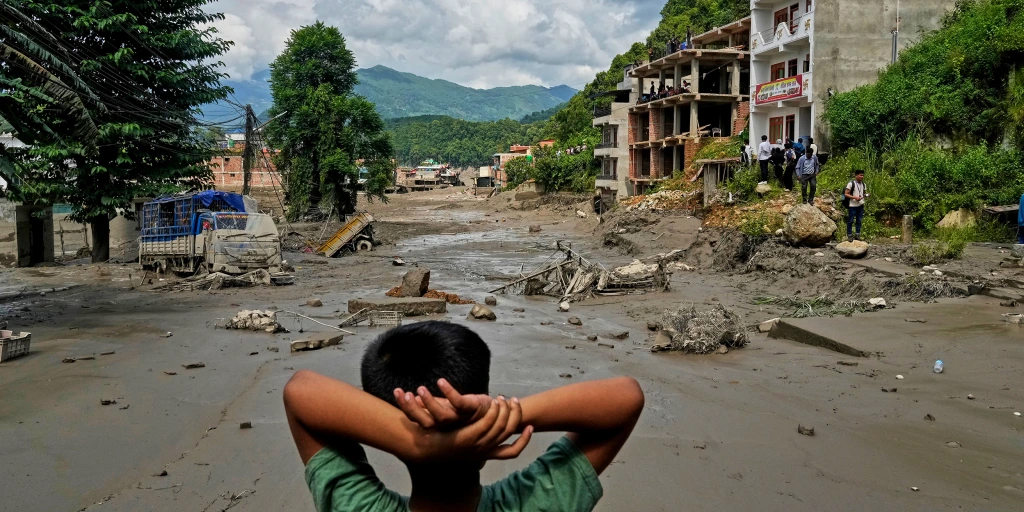
Hundreds of foreign nationals are among those missing after devastating floods and landslides swept through communities along Nepal’s Trishuli River and across the country’s border with China, leaving families in several countries anxiously waiting for news of their loved ones.
The disaster struck on Wednesday after floodwaters cascaded through deep mountain gorges and overwhelmed settlements along the river, affecting communities in Nepal’s Rasuwa, Nuwakot and Dhading districts, as well as China’s Gyirong Port, a major border crossing.
Officials had yet to release the names of those confirmed dead or missing as rescue operations continued on Thursday, but the scale of the disaster was becoming clearer as families and friends turned to social media to seek information about people who remained unreachable.
The affected area is home to more than half a million people, including members of the Tamang, Gurung and Newar communities, many of whom depend on agriculture and tourism for their livelihoods. The region is also a major destination for trekking, rafting and religious pilgrimage, attracting visitors from Nepal and other countries.
At least 517 foreign nationals were reported missing in Nepal, according to figures from the Nepal Tourism Board. Indian nationals accounted for at least 178 of those missing, while other affected nationalities included 65 Americans, 53 Ukrainians, 51 Malaysians, 35 Australians, 33 Britons and 25 Canadians.
On the Chinese side of the border, state media reported that 558 people were missing, including at least 260 foreign nationals.
Many of those missing were tourists and pilgrims who had travelled into the region during the summer period. Among them were children, including a 14-year-old American girl and two Australian boys aged 12 and 14 who were reportedly travelling with a tour group that became unaccounted for.
For families living thousands of kilometres away, the disaster has become a desperate wait for information.
Radhika Sharma, whose parents, Ramesh and Neelam Sharma, were part of a religious pilgrimage to the region, said she had not heard from them since their tour group reached the Tibet border on Wednesday morning.
She described the period since then as the “worst 24 hours” of her life.
In the United States, members of Nepal’s diaspora have also been searching for friends and relatives, while similar concerns have emerged among Nepali communities in Canada and other countries.
Pema D. Gurung, who owns a Nepali restaurant in New York, said he had been unable to establish contact with several friends in Rasuwa after the flooding disrupted communication.
“In my mind and in my heart, I’m hoping my friends are alive,” Gurung said, expressing fears shared by many families following the disaster.
Read also: Kenya Floods Kill 42 as Tourists Evacuated from Nairobi
In Ottawa, Canada, Rojina Dhungana said her parents had survived but several people she knew from her hometown remained missing.
She said social media had become a channel through which residents and members of the diaspora were desperately searching for relatives, friends and neighbours.
The disaster has also exposed the vulnerability of communities that have repeatedly faced major natural disasters.
Parts of Rasuwa and neighbouring districts have historically experienced high levels of poverty, while their mountainous terrain leaves communities vulnerable to landslides, floods and other climate-related disasters.
Some families living along the Trishuli River had themselves been displaced by the devastating 2015 earthquake, which killed more than 8,000 people across Nepal. After losing their homes, hundreds of families were resettled on low-lying areas along the river, where they now face another major disaster.
The region’s importance as a tourism and pilgrimage corridor has also increased the number of people exposed to such hazards.
Every summer, hundreds of Hindu, Buddhist, Jain and Bonpo pilgrims travel through the area towards Tibet’s Mount Kailash, while tourists and trekkers use the same routes to explore Nepal’s mountainous landscape.
The area has also attracted major investment in hydropower, with foreign-backed projects contributing to the movement of workers and other nationals into remote parts of the country.
At least nine South Korean nationals among those affected were workers involved in the construction of a hydropower plant, according to South Korean officials.
Nepal has sought to expand its hydropower sector because of its substantial water resources, with investments from neighbouring China and India helping to drive development in the industry.
But the latest disaster has raised fresh concerns about the risks faced by communities, workers and visitors operating in difficult mountainous terrain.
Rescue teams continued their efforts on Thursday as authorities worked to assess the extent of the destruction and locate those who remained missing.
With communication networks disrupted in several affected areas and officials yet to publish a complete list of casualties, families in Nepal and abroad remained uncertain about the fate of their loved ones.
For the communities along the Trishuli River, however, the disaster is more than a story about missing tourists and foreign nationals. It has struck villages whose residents were already living with poverty, the memory of previous disasters and increasing exposure to extreme weather.
As rescue efforts continue, the immediate priority remains finding survivors and accounting for those still missing, while the scale of the destruction becomes clearer.