
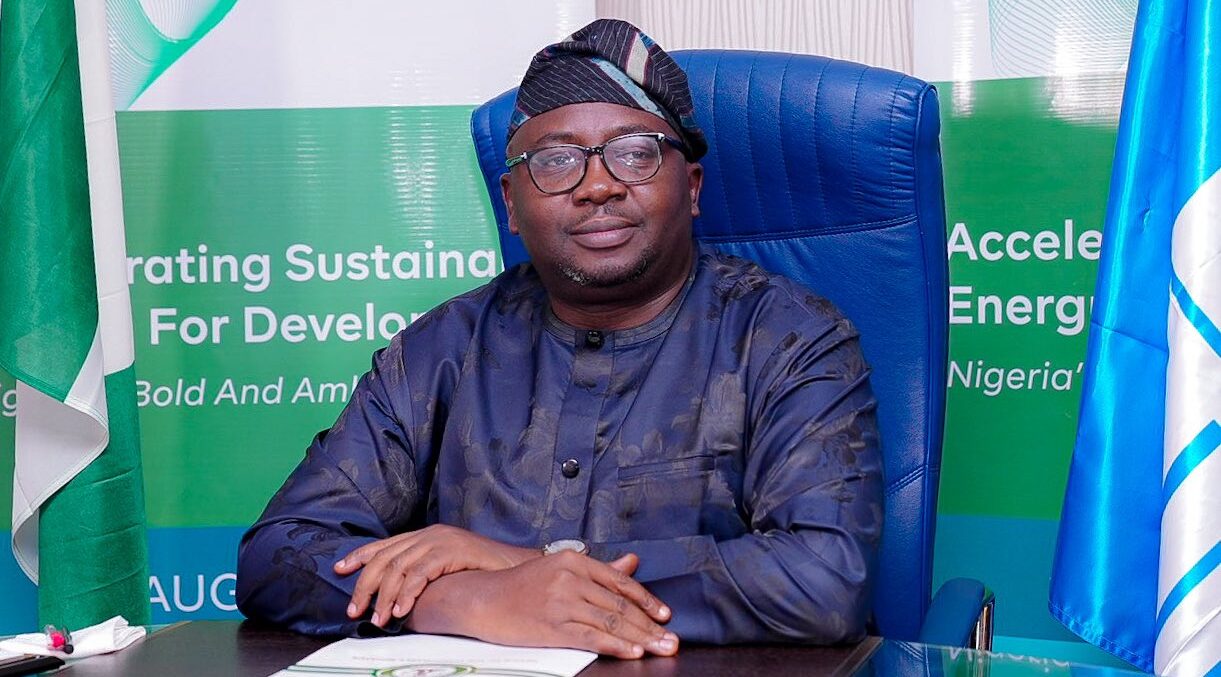
Adelabu – Kaduna Power Plant would become operational before the end of 2025
Minister of Power, Adedayo Adelabu, has revealed that approximately 150 million Nigerians now have access to adequate electricity, although 80 million people still lack reliable power.
He made the announcement at the 2025 Ministerial Sectoral Update Conference in Abuja on Thursday.
Adelabu stated that the progress is linked to Nigeria’s involvement in the Mission 300 initiative, an ambitious programme by the World Bank and African Development Bank (AfDB) to expand electricity access to 300 million Africans by 2030.
“The compact sets ambitious goals to enhance electricity access, increase renewable energy adoption, and improve clean cooking solutions for millions of Nigerians — that is Mission 300, and we are making good progress on this,” he said.
Nigeria, a country of over 240 million people, currently provides electricity access to about 150 million citizens. Adelabu stressed that the challenge goes beyond access to issues of reliability.
“As it is today, Nigeria—a country with about 240 million people—has access for 150 million people already, while about 80 million lack access to adequate electricity in Nigeria,” he said. “The real challenge lies in the stability and affordability of electricity. That’s how we measure reliability. We must ensure that those who have access enjoy consistent and affordable power.”
Speaking on Nigeria’s contribution to the Mission 300 initiative, he noted, “I’m happy to tell you that out of the 300 million Africans that the World Bank and AfDB aim to reach, Nigeria is on course to account for no less than 25 per cent, which translates to about 75 million Nigerians. When we presented our compact, they agreed with us.”
 Read also: UNIBEN MACSAN Hosts “Empower A MACSAN Conference 2025” to Inspire Student Growth
Adelabu urged international financiers to invest not just in off-grid renewable solutions but also in reinforcing Nigeria’s national grid. He cautioned against an overemphasis on renewables, saying it might leave urban centres and industries neglected.
“When you’re extending access to the 300 million people under this initiative, let’s not concentrate solely on renewable energy—which is more appropriate for rural communities,” he said.
“Strengthening grid infrastructure is equally crucial so that those connected to the grid can enjoy reliable power. Otherwise, how do we explain the growing number of Nigerian companies opting out of the national grid to generate captive power?,” he added.
He also noted recent strides in the country’s generation capacity, “We have increased our generation to 6,003 megawatts, up by 1,700 megawatts in one and a half years since President Tinubu assumed office.”
“It took Nigeria over 40 years to achieve an incremental 2,000 megawatts of average energy; we achieved this in less than two years. Past administrations have their positives, but if they had been adding at least 1,000 megawatts of power since 1999, we would be talking about 26,000 megawatts and more in Nigeria.”
“Now that we (the current administration) have created the trajectory, if we can sustain it, I can assure you that before the end of this administration’s first term in 2027, we should be able to generate and distribute nothing less than 8,000 megawatts of power,” he declared.
The minister also announced that the Kaduna Power Plant would become operational before the end of 2025, a project expected to further boost national supply.
On the longstanding issue of metering, Adelabu reassured Nigerians that the gap would soon close. “The metering gap will soon be a thing of history,” he said.
Addressing financial reforms in the sector, Adelabu disclosed that recent electricity tariff changes had increased revenue by ₦700 billion.
In April 2024, the Nigerian Electricity Regulatory Commission (NERC) approved a steep tariff hike for Band A customers from ₦68 to ₦225 per kilowatt-hour, a move that affected around 1.9 million customers enjoying at least 20 hours of electricity daily.
The government explained that subsidy costs, projected to reach ₦2.9 trillion in 2024, made the hike inevitable. Though, ₦2.8 trillion was still allocated to electricity subsidies for the year. The tariff adjustment was estimated to slash subsidy obligations by ₦1.14 trillion.
However, the decision has sparked criticism from stakeholders. The Institute of Chartered Accountants of Nigeria (ICAN) described it as an additional burden on already struggling citizens, while the Abuja Chamber of Commerce and Industry warned that the increase would raise the operating costs for small and medium-sized enterprises (SMEs).
Read also: FG to Launch E-Visa, Digital Landing Cards from May 1
Despite the generation improvements, Nigeria’s grid continues to face challenges. In 2024 alone, the national grid collapsed at least 12 times, causing widespread blackouts across major cities including Abuja, Lagos, and Kano.
Advocating for structural reforms, Adelabu called for the regionalisation of the grid to prevent total national shutdowns. He said ageing infrastructure, vandalism, and inconsistent gas supply to thermal power plants remain critical issues, which the Transmission Company of Nigeria (TCN) also acknowledged.
Finally, the minister lamented Nigeria’s heavy reliance on imported power equipment, noting its negative impact on foreign exchange reserves.