Happy Children’s Day, Nigeria.
Now, Where Are The Children?
Today, Nigeria will organise parades, cut cakes, post smiling photographs, and call children “the future.” But somewhere in the darkness, children taken from classrooms are still missing. And a country that cannot protect its children has no moral right to celebrate itself.
May 27, 2026
Every year on May 27, Nigeria performs hope.
Schools iron uniforms for parades. Governors rehearse speeches about “leaders of tomorrow.” Television stations roll out cheerful montages of children dancing in oversized blazers while soft piano music plays underneath. Social media fills with carefully curated captions about the importance of protecting the next generation.
Every year, adults who have spent decades failing this country’s children suddenly remember the phrase “our future.”
This is also the same country that recently returned to the old national anthem with promises of patriotism, moral renewal, and national identity.

“Our flag shall be a symbol that truth and justice reign.”
“To hand unto our children a banner without stain.”
Beautiful words.
Words that feel almost painful now.
Because what exactly are we handing over to Nigerian children today?
Fear?
Abduction?
Hunger?
A country where parents now pray not only for academic success, but simply for their children to return home alive?
For an administration that insisted on bringing back this anthem as a symbol of national values, you would expect those values to mean something beyond ceremony.
You would expect truth to matter.
You would expect justice to exist.
You would expect children to at least be safe inside classrooms.
Instead, we have become a nation endlessly reciting beautiful lyrics over ugly realities.
But this year, the performance feels unbearable.
Because while the nation prepares balloons and hashtags, there are children who disappeared from classrooms and never came home.
Not from a war zone.
Not from the middle of a battlefield.
From school.
From the one place society promises parents should be safe.
A classroom is supposed to represent certainty. It is supposed to mean structure, safety, routine, possibility. A parent drops a child there with trust. A teacher stands before a blackboard believing knowledge matters more than violence.
And yet armed men walked into that promise and shattered it.
The children taken in Oyo State are not statistics floating across a news ticker. They are not numbers to be squeezed into a government statement before the next press conference begins.
They are children.
They have names.
Some of those still missing from Oyo State:
Rashida Tajudeen — 11 years old.
Eleven. An age where your biggest concern should be homework and friendship and whether your handwriting is neat enough for your teacher to praise.
Baraka Abioye— 16 years old.
An age where futures begin to take shape. University dreams. Teenage ambitions. The fragile excitement of becoming.
Fatimo Jimoh— 15 years old.
Hassan Azeez — 14 years old.
Juwon Sunday — 7 years old.
Seven. Still young enough to fear darkness.
Christianah Akanbi — 2 years old.
Two.
Pause there.
A two-year-old child is missing in Nigeria today.
And the country still expects celebration.
Idowu Taiwo — 4 years old.
Ahmed Ramoni— 8 years old.
Tosin Abadi— 9 years old.
Deborah Adebowale — 5 years old.
Waliya Bello— 4 years old.
Hannah Ojo — 14 years old.
Mary Gabriel — 6 years old.
Jacob Gabriel — age unknown.
Read those names again.
Slowly.
Because this country has a terrible habit of turning tragedy into background noise.
We scroll past suffering too quickly. We move on before grief has even settled. We reduce horror into trends, hashtags, and statistics until human beings disappear beneath the language.
But somewhere tonight, parents are staring at ceilings they cannot sleep beneath.
Somewhere, a mother is replaying the last morning she saw her child alive.
Somewhere, a father is trying to stay emotionally upright because his family cannot survive if he collapses too.
And somewhere in the middle of all this, government officials are still speaking in rehearsed tones about “security challenges.”
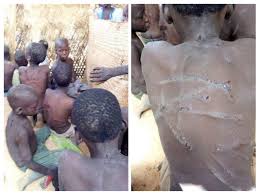
Challenges!
Meanwhile, photographs and videos allegedly showing some of these children being beaten and tortured continue to circulate online.
And perhaps that is the most terrifying part of all.
Not just the violence itself, but the audacity behind it.
The confidence.
The absence of fear.
The belief that children can be abducted, brutalised, filmed, and displayed online without consequence.
That is not ordinary criminality.
That is what happens when criminals no longer fear the state.
It is a public demonstration of how powerless this country increasingly appears before the people terrorising its citizens.
Read Also: Police Rescue 18 Stolen Children in Abia, Arrest 10 Suspects
Now, this line hits very hard and would work beautifully right before “Bring them home first”:
A nation cannot sing about handing children “a banner without stain” while handing them fear instead.
As though children vanishing from classrooms is merely an administrative inconvenience.
Teachers were taken too.
Mrs. Alamu Folawe — a principal. A woman who chose to spend her life helping build the minds of other people’s children in a country that rarely rewards teachers with dignity.
Mr. Michael Oyedokun — killed.
Joel Adesiyan, the assistant headmaster — killed while trying to escape.
Think about the cruelty of that.
These were not politicians protected by convoys.
Not men with bulletproof SUVs and heavily armed escorts.
These were educators.
People who woke up in the morning, dressed for work, and entered classrooms believing they would return home alive.
They paid for that belief with everything.
The cruelest thing about this country is not merely that it fails its children. It is that it repeatedly asks those same children to celebrate inside the ruins of that failure.
Now, there is a question supporters of the current administration constantly ask whenever criticism becomes impossible to ignore:
“What assurance do we have that another person will do better?”
At first glance, it sounds reasonable.
Until you realise what the question actually means.
It means Nigerians are being asked to lower their expectations so drastically that survival itself becomes acceptable governance.
It means citizens should remain emotionally loyal to failure simply because improvement is not guaranteed.
It is the logic of people trapped in a collapsing building arguing that escape may also be dangerous.
Of course it may be.
But staying inside a burning structure guarantees destruction.
Even if another administration eventually disappoints Nigerians too, at minimum there would at least be certainty that the current damage is no longer continuing under the same hands.
That matters.
When treatment is killing a patient, you do not insist they remain with the same doctor because the next one might also be imperfect.
You stop the bleeding first.
Then you search for healing.
And let us be honest about the scale of what Nigerians have endured.
Within months of subsidy removal, the naira collapsed from roughly ₦460 to over ₦1,500 against the dollar.
Food prices exploded.
A bag of rice that once sat below ₦30,000 climbed beyond ₦80,000.
Electricity tariffs surged for Band A consumers while millions still live with unreliable power.
Transport costs became unbearable.
Rent became suffocating.
Hope itself became expensive.
Meanwhile, insecurity continues swallowing ordinary people whole.
Students are abducted.
Farmers are attacked.
Entire communities live with fear as a permanent roommate.
And somehow, despite all this, political theatre continues uninterrupted.
Convoys still move.
Rallies still hold.
Speeches still happen.
The distance between political leadership and ordinary suffering in Nigeria has become so vast that it sometimes feels like two completely different countries occupy the same map.
The bar for governance is now buried underground.
“Doing better” no longer requires brilliance.
It requires basic humanity.
The mathematics refuse to make sense
The numbers are not adding up.
Numbers matter because numbers tell stories governments sometimes cannot.
According to reports surrounding the APC primary, Bola Tinubu reportedly secured approximately 11 million votes.
Pause there again.
Eleven million votes.
Inside a party primary.
Now compare that with the 2023 presidential election, where he officially secured 8.79 million votes nationwide.
A national election involving over 93 million registered voters produced fewer votes than an internal party exercise restricted to party members.
Think carefully about how strange that sounds.
Either APC members displayed extraordinary enthusiasm internally while millions somehow vanished during the general election, or the figures themselves were designed less as transparent democratic accounting and more as political spectacle.
Neither interpretation inspires confidence.
One suggests weakness.
The other suggests manipulation.
Both are disturbing.
And yet these are the numbers surrounding a man seeking another four years.
Everything about Nigerian politics increasingly feels disconnected from ordinary reality.
Citizens struggle to buy food while politicians compete over optics.
Children disappear while political machinery focuses on power retention.
Read Also: Over 50% of Nigeria’s displaced persons are children – NBS
And perhaps most dangerously of all, many Nigerians are slowly becoming emotionally numb to contradictions that should shock them.
That numbness is dangerous.
Because the moment citizens stop reacting to absurdity is the moment absurdity becomes normal.
“A country dies slowly when its people begin treating outrage like routine.”
To the young Nigerians already giving up
I understand the exhaustion.
Truly.
Many young Nigerians feel betrayed by politics itself.
They marched during ENDSARS believing their voices mattered.
They registered for PVCs believing participation could reshape the country.
Many watched election results emerge that felt disconnected from what they believed they witnessed.
Then the courts spoke.
And for many young people, something inside them hardened.
A dangerous kind of hopelessness settled in.
Not loud hopelessness.
Quiet hopelessness.
The kind that says:
“What is the point?”
And honestly, that question is understandable.
But here is the problem.
Withdrawal does not punish power.
It protects it.
Refusing to vote may feel emotionally satisfying in the short term, but politically, silence creates space for organised structures to dominate uncontested.
Even when systems appear compromised, participation still matters.
Because numbers matter.
Records matter.
Pressure matters.
Witness matters.
And perhaps most importantly, effort matters.
One day, another generation of Nigerians will ask what this generation did while the country was breaking.
What will we say?
That we were too exhausted to try?
Exhaustion is real. Nobody should dismiss it.
But history has never been changed by people who waited to feel fully rested before resisting collapse.
Every meaningful movement began with tired people.
Frustrated people.
Disappointed people.
People who had every reason to quit and still decided to show up anyway.
Because the truth is that most Nigerians do not have the luxury of escape.
Not everyone can relocate abroad.
Not everyone has foreign currency savings.
Not everyone can buy distance from dysfunction.
For millions, this country is all there is.
And the children growing up inside it deserve more than inherited hopelessness.
Those missing children from Oyo State will grow up — if they return safely — inside the Nigeria this generation leaves behind.
The two-year-old.
The seven-year-old.
The fifteen-year-old imagining adulthood.
Their future will be shaped by whether citizens decided democracy was still worth the inconvenience of participation.
Maybe change will not arrive immediately.
Maybe the road is longer than one election cycle.
Maybe disappointment will happen again.
But surrender guarantees permanence.
And permanence is exactly what broken systems depend on.
#Bring them home first
So, happy children’s day? No, not like this.
Not this year.
Not while children remain missing.
Not while classrooms continue to feel vulnerable.
Not while grief and political performance occupy the same national stage.
Nigeria cannot continue treating children as ceremonial decorations every May while failing them every other month of the year.
Children are not campaign imagery.
They are not emotional props.
They are human beings owed safety, dignity, education, and a future.
And until that future exists in something more meaningful than speeches, celebration feels hollow.
Bring them home first.
Then let us talk about parades.
Bring them home first.
Then let us discuss the future.
Bring them home first.
Then perhaps this country can finally look its children in the eye without shame.
#BringThemHome