
NELFUND: Why is it Necessary for Indigent Students in UNIBEN?
Nigeria today has become a country where the cost of education keeps rising, while many families’ incomes stay the same or even fall. Support for students from low-income backgrounds is not just important anymore, it has become urgent.
The launch of the Nigerian Education Loan Fund (NELFUND) is one such support system. It offers hope to many students in universities like the University of Benin (UNIBEN), where a lot of students find it hard to continue their studies because of financial difficulties.
NELFUND, a Federal Government established loan initiative, is designed to provide interest free loans to indigent Nigerian students pursuing higher education. It was established out of the Student Loan Act and signed into law by President Bola Ahmed Tinubu in June 2023.
The loans are for tuition fees and other educational costs and must be repaid after graduation once the student has a job. This initiative is similar to successful education loan models in developed countries but with changes to suit Nigeria’s economic conditions.
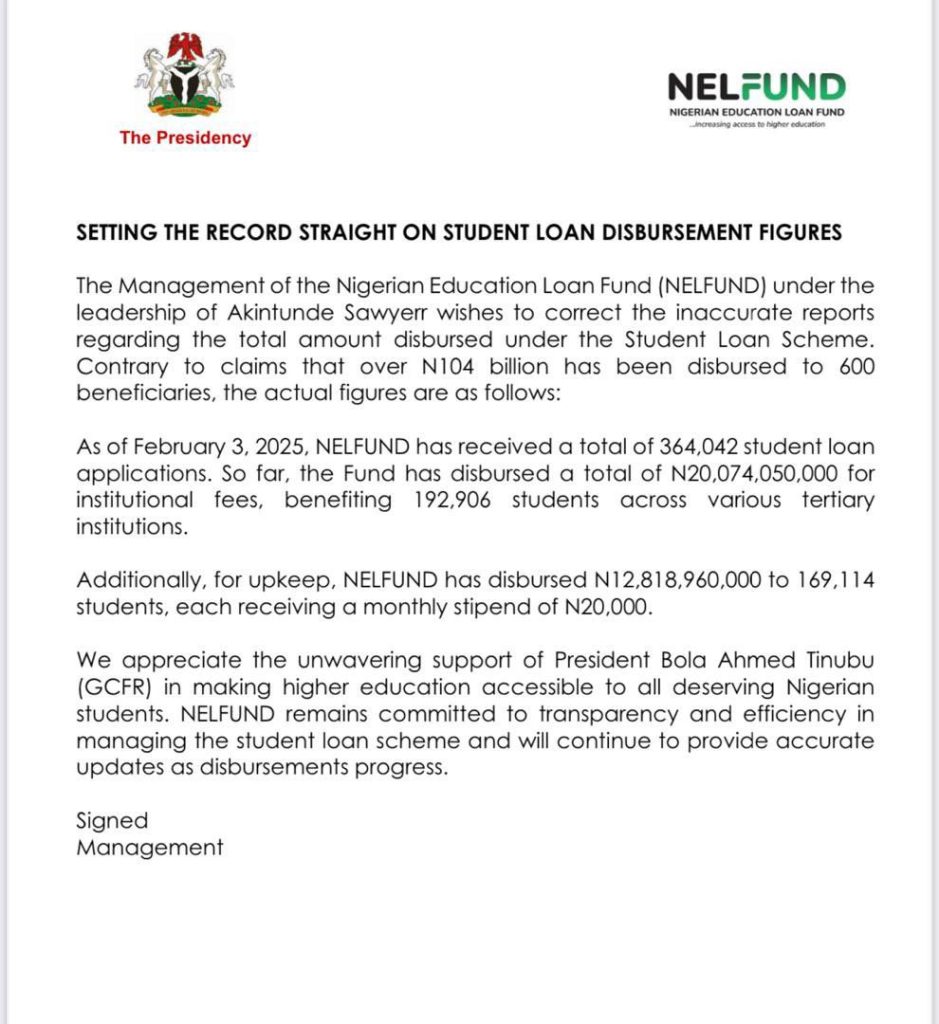
According to data gotten from NELFUND’s official website (nelf.gov.ng), currently over 191,000 students have been supported in the 37 states with 137,000 being male and 55,000 being females.
Read also: NELFUND Embarks on Tech-Driven Student Loan Revolution
Over 37 billion naira in loans have been disbursed. 36 colleges of education with 18,099 students, 33 polytechnics with 4,270 students, and 89 universities with 288,031 students have benefited so far.
Students who are academically sound but financially disadvantaged will now have the chance to complete their studies without fear of dropping out. The goal of NELFUND aligns with Sustainable Development Goal 4 of the United Nations, which seeks to “ensure inclusive and equitable quality education and promote lifelong learning opportunities for all.”

The implementation of this initiative carries not just an administrative duty but a moral one. It addresses an important question like, should access to quality education be a privilege of the rich or a right of every Nigerian youth regardless of background?
According to UNESCO, approximately 20 million Nigerian children and youth are currently out of school. Some of these students drop out due to sociocultural barriers and a significant number are forced to leave school because of poverty.
The University of Benin, one of Nigeria’s foremost institutions of tertiary learning, is attended by thousands of brilliant students, many of whom are first-generation university attendees, that is, some of them are the first in their families to attend a university.
These students are often faced with depressing choices, between feeding and buying textbooks, between paying fees and dropping out. Despite the availability of NELFUND, UNIBEN has seen low enrolment into the scheme.
On December 11, 2024, Daily Post reported that the Vice Chancellor of the University of Benin, Professor Edoba Omoregie, decried the low enrolment rate of students of the institution into the Nigerian Education Loan Fund scheme.
Prof. Omoregie raised the concerns during a meeting with the officials of the Nigerian Education Loan Fund, NELFUND, in Abuja. According to a statement from the Public Relations Office of the school made available to journalists in Benin City, the Vice Chancellor was in the NELFUND office to discuss the prospect of getting more UNIBEN students enrolled into the scheme.
Responding to the request, the Executive Director, Operations at NELFUND, Mustapha Iyal, attributed inadequate sensitization and doubt about the authenticity of the fund as primary reasons for the low enrolment.
Iyal, who, alongside other officials, received the Vice Chancellor, expressed readiness for the scheme to include as many students of the University as possible only if they apply and meet the guidelines.
Education is a fundamental human right. It should not be determined by the economic status of one’s parents. This situation makes the case for NELFUND not just persuasive but imperative. If students do not get financial support soon, we risk losing talented people, weakening our education and research systems, and harming our country’s progress.
Lack of funds means students will go hungry, miss lectures due to transportation costs, and will not be able to afford essential learning materials. In many cases, female students are particularly vulnerable, sometimes forced into compromising situations to meet financial demands.
Read also: Nigeria’s Green Opportunity: Leading Africa into the Expanding Carbon Market
These are avoidable tragedies that an efficient and compassionate education loan system like NELFUND can prevent. In the last five years, tuition fees in Nigerian public universities have risen by over 100%. For example, UNIBEN’s tuition fees for some courses rose from around 45,000 thousand naira to over 150,000 thousand naira between 2022 and 2025.
Although Nigeria’s minimum wage was 30,000 thousand naira in 2023 and has increased to 70,000 thousand naira per month in 2024, there is still a big difference that leaves many families unable to afford education costs. Without financial aid like NELFUND, many students will simply not be able to continue their education.
In the words of Prof. Tahir Mamman, Nigeria’s Minister of Education, “We cannot afford to exclude a generation of Nigerians from higher education simply because they are poor. NELFUND is an instrument of social justice and equal opportunity,” he said.
The NELFUND initiative, if properly implemented and monitored, offers a sustainable solution to a long-time problem. It empowers students to own their educational journey, placing the responsibility of repayment after graduation when they are gainfully employed. This approach not only provides immediate relief but also instills a sense of responsibility, commitment, and civic consciousness.
Thousands of talented Nigerian youths seek education abroad because they see no hope at home. By making local universities more affordable and accessible through NELFUND, Nigeria can prevent the outflow of human capital and retain talent needed for national development.
For students in UNIBEN, the impact of NELFUND could be very transformative. UNIBEN’s Faculty of Education recently recorded an alarming number of students deferring their studies due to financial hardship.
According to a student welfare report in the Faculty of Education (2024), more than 1,200 students deferred their studies due to inability to pay tuition. Some students resorted to business and working night shifts just to stay enrolled.
Imagine what could happen if this situation continues, so many bright futures will be lost just because students can’t afford to pay their school fees. NELFUND can be the support that helps thousands of students stay in school and keep working towards their dreams.
Financial anxiety significantly affects students’ mental health. According to the Nigerian Mental Health Survey (2022), 60% of students battling financial problems reported severe depression or anxiety. By easing financial burdens, NELFUND can improve not only academic outcomes but the overall well-being of young Nigerians.
Although the aim of the fund is good, its implementation should not be left to bureaucratic delays. The eligibility criteria must be broad enough to include those most in need. Accessibility should be easy, the distribution process must be clear and free from political influence or favouritism.
The repayment plan should be sensible, considering the high unemployment rates among young graduates. Globally, education loan schemes have been used successfully. The United Kingdom’s Student Loans Company and the United States’ Federal Student Aid system are good examples.
Although they face some challenges, they have helped millions of people reach their academic and career goals. Nigeria can learn from these models and adjust them to fit its own social and economic needs. UNESCO Director-General Audrey Azoulay stated in a 2023 policy brief that, “Education financing is not an expense, it is an investment in people and in peace.”
This statement must echo in the chambers of Nigerian policymakers and within the corridors of universities like UNIBEN. A well-educated population is not just an economic asset; it is the bedrock of a stable, inclusive, and innovative society.
The spiritual and moral dimensions of education must also not be overlooked. Education liberates. It enlightens. It empowers. NELFUND is not merely a financial instrument; it is a channel of redemption for families trapped in cycles of poverty. It is a tool for fostering equality in a society deeply fragmented by wealth disparity.
Based on ethics, denying a willing and able student access to education due to financial incapacity is a societal failure because it violates the principle of distributive justice and runs contrary to the constitutional right to education as enshrined in Section 18 of the 1999 Nigerian Constitution.
It is also important to note that investing in education is a proven catalyst for national development. The World Bank has repeatedly stressed that no country has achieved sustained economic growth without an educated population.
 Read also:
For Nigeria to harness the potential of its vast youth population, institutions like NELFUND must be strengthened, not politicised. UNIBEN has a proud legacy of excellence. With fewer students dropping out and more students excelling, the university itself will grow stronger while producing graduates who enhance its reputation globally.
Access to NELFUND will strengthen UNIBEN’s ability to deliver on its mission of producing quality graduates for Nigeria and beyond. The university’s leadership should also engage stakeholders, including alumni, civil society, and the media, to create awareness, ensure proper utilisation, and demand accountability in the management of NELFUND.
In conclusion, NELFUND is not just necessary, it is urgent, timely, and fair. It brings hope where there is none, order where there is confusion, and fairness where there is exclusion. For students who are struggling in UNIBEN, it is the link between their potential and their future opportunities.
The Federal Government, in partnership with institutions like UNIBEN, should make sure this fund doesn’t become just another good idea wasted by poor management. Policymakers should also ensure that the loan system is very inclusive.
Students with disabilities should be involved. If we want to build a country where no one’s dreams are held back by poverty, the solution is simple, support and improve NELFUND for the benefit of everyone.
Let Nigeria take on the challenge. Let UNIBEN take the lead. Let education be the powerful force for global equality as it was always meant to be.