
By Esohe Aifuwa
Kemi Badenoch’s Post Fuels Racism Reply and Identity Clash
The recent statements made by the Conservative Party Leader, Kemi Badenoch , has prompted racist reply from Britain X users over national identity.
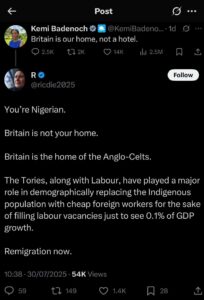
Speaking through her X handle, he said, “Britain is our home, not a hotel.” This prompted a viral racist reply that has ignited a fierce debate over race, immigration, and national identity across the UK.
The controversy, centered on Badenoch’s remarks and the xenophobic response has drawn widespread attention on social media.
The inflammatory reply came from user @ricdie2025, who wrote: “You’re Nigerian. Britain is not your home. Britain is the home of the Anglo-Celts… Remigration now.” Viewed over 50,000 times, the comment’s white nationalist rhetoric sparked outrage, with many condemning its overtly racist tone.
Badenoch, who is a British leader, was born in the UK to Nigerian parents and raised partly in Nigeria and the US, has long navigated complex questions about her identity. Her recent criticisms of Nigeria have fueled tensions.
Read more:https://mediaerrandsnews.com/starmer-says-badenoch-unfit-to-be-uk-pm/
In December 2024, she claimed, “The Nigerian police stole my brother’s shoes and wristwatch. They’re basically armed robbers with uniforms,” prompting backlash from Nigerian media and officials who accused her of perpetuating colonial stereotypes, She also alleged that Nigerian citizenship laws prevented her, as a woman, from passing citizenship to her children, a claim debunked by legal experts and Nigerian outlets like Premium Times and Punch, which confirmed both parents can confer citizenship.
Furthermore, Nigerian Vice President Kashim Shettima and other leaders have criticized Badenoch, alleging she leverages her heritage selectively to bolster her political standing in Britain. As Conservative Party Leader, her statements carry heightened significance amid ongoing national debates over immigration and identity.
The racist reply has intensified scrutiny of how Badenoch balances her British-Nigerian identity. Supporters argue she promotes a cohesive British identity, while critics, including some Nigerian officials, contend she distances herself from her roots to appeal to nationalist voters.